Green Cleaning Certifications for Offices: The Complete Guide
Modern corporate leaders and facility executives face growing pressure to manage workplaces that are not only spotless, but also environmentally sustainable and safe for occupants. As commercial operations prioritize environmental, social, and governance (ESG) commitments, corporate janitorial practices are undergoing an important shift.
Evaluating verified green cleaning certifications for offices has become essential for property managers seeking to eliminate corporate “greenwashing,” safeguard employee wellness, and protect fragile indoor ecosystems.
The global market is flooded with cleaning solutions claiming to be “all-natural,” “eco-safe,” or “earth-friendly.” Without rigorous independent verification, these ambiguous claims rarely hold up to scientific scrutiny. Understanding how third-party green cleaning credentials evaluate chemical toxicity, packaging sustainability, and operational protocols is the most reliable way to select true eco-friendly commercial janitorial solutions for your workplace.
What Defines an Authentic Green Cleaning Standard?
At its core, green cleaning goes far beyond simply purchasing plant-derived surface sprays. An authentic green program is an integrated operational standard that reduces environmental impact across the entire life cycle of workplace sanitation. It evaluates cleaning chemical formulation, equipment energy consumption, particulate containment, and staff application training.
Traditional commercial cleaning formulations frequently contain high levels of volatile organic compounds (VOCs), endocrine disruptors, chlorine bleach, and synthetic fragrances. When custodial teams disperse these chemicals across sealed corporate office buildings, the volatile agents aerosolize and linger in the heating, ventilation, and air conditioning (HVAC) loops.
According to research documented by the U.S. Environmental Protection Agency (EPA), concentrations of many volatile organic compounds are consistently two to five times higher indoors than outdoors. For office workers spending forty hours a week in closed rooms, chronic exposure to airborne chemical residues can provoke respiratory inflammation, eye irritation, chronic migraines, and cognitive fatigue.
Authentic green credentials establish strict chemical exposure ceilings, ban known carcinogens, and require documented indoor environmental safety.
Quick-Glance Summary: Leading Green Cleaning Certifications
The table below outlines the premier third-party certifications, their evaluative focus, governing bodies, and primary operational benefits for modern corporate office spaces:
| Certification / Standard | Primary Evaluation Scope | Governing Body | Key Corporate Value |
| Green Seal (GS-37 / GS-40) | Chemical toxicity, packaging, product manufacturing lifecycle | Green Seal Inc. (Independent Non-Profit) | Guarantees zero carcinogens, mutagens, or heavy reproductive toxins |
| UL ECOLOGO | Multi-attribute environmental impact and material sustainability | UL Solutions | Validates reduced lifecycle pollution, resource conservation, and biodegradability |
| EPA Safer Choice | Direct ingredient screening against strict toxicological criteria | U.S. Environmental Protection Agency | Ensures every chemical ingredient meets stringent human and planetary safety thresholds |
| CIMS-Green Building (GB) | Management systems, cleaning service delivery, and green operations | ISSA (The Worldwide Cleaning Industry Association) | Validates that a commercial service contractor implements genuine sustainable practices |
| LEED v4.1 for O+M | Whole-building operational performance, including janitorial | U.S. Green Building Council (USGBC) | Awards direct prerequisite credits toward sustainable commercial building certification |
The Big Three: Product-Level Environmental Standards
When assessing green cleaning certifications for offices, facilities teams must distinguish between product-level credentials (which certify individual chemicals or consumables) and organization-level certifications (which evaluate the cleaning contractor performing the work).
Three independent organizations set the benchmark for chemical and material verification across North America:
1. Green Seal (GS-37 & GS-40)
Established in 1989, Green Seal is one of the most recognized third-party ecolabels in the commercial building sector. For commercial office environments, the GS-37 standard governs general-purpose, bathroom, glass, and carpet cleaners intended for industrial and institutional use, while GS-40 covers floor-care products.
Green Seal certification requires rigorous performance testing. A chemical cannot simply be non-toxic; it must clean just as effectively as standard industrial detergents at recommended dilution levels.
Furthermore, Green Seal prohibits compounds categorized as human carcinogens, reproductive toxins, asthmagens, or alkylphenol ethoxylates. It mandates strict limits on VOC content and requires that all plastic packaging contain post-consumer recycled content.
2. UL ECOLOGO
Administered by UL Solutions, the ECOLOGO mark signifies that a cleaning agent has undergone rigorous multi-attribute lifecycle testing.
Unlike single-attribute certifications that focus exclusively on toxicity or recycled packaging, ECOLOGO evaluates a product’s environmental footprint from raw material extraction through manufacturing, shipping, customer usage, and disposal.
ECOLOGO standards assess:
- Aquatic toxicity and rapid biodegradability to ensure discharged wash water does not harm municipal water supplies or aquatic ecosystems.
- Energy and water consumption during the manufacturing and distribution process.
- Strict safety limits on skin and eye corrosiveness, reducing the risk of workplace accidents for custodial personnel.
3. EPA Safer Choice
The Safer Choice program is operated directly by the U.S. Environmental Protection Agency. To earn the Safer Choice label, chemical manufacturers must disclose their complete ingredient profile including proprietary fragrance blends and preservatives to an independent third-party toxicological review team.
Every chemical ingredient is evaluated against the EPA’s Master Criteria for Safer Chemicals. If an ingredient poses an avoidable hazard to human health or the environment, it must be substituted with a safer, functional alternative before the product is approved.
For facilities teams, selecting Safer Choice solutions provides immediate assurance that daily surface disinfectants and hand soaps contain no hidden hazardous substances.
Organizational Certifications: Verifying Commercial Service Providers
Stocking an office supply closet with eco-labeled bottles does not automatically create a sustainable facility program. If janitorial personnel use improper dilution ratios, cross-contaminate high-touch surfaces, or deploy outdated vacuum filters that blast dust into the air, the benefits of eco-friendly chemicals are lost.
This is why organization-level green cleaning certifications for offices are crucial.
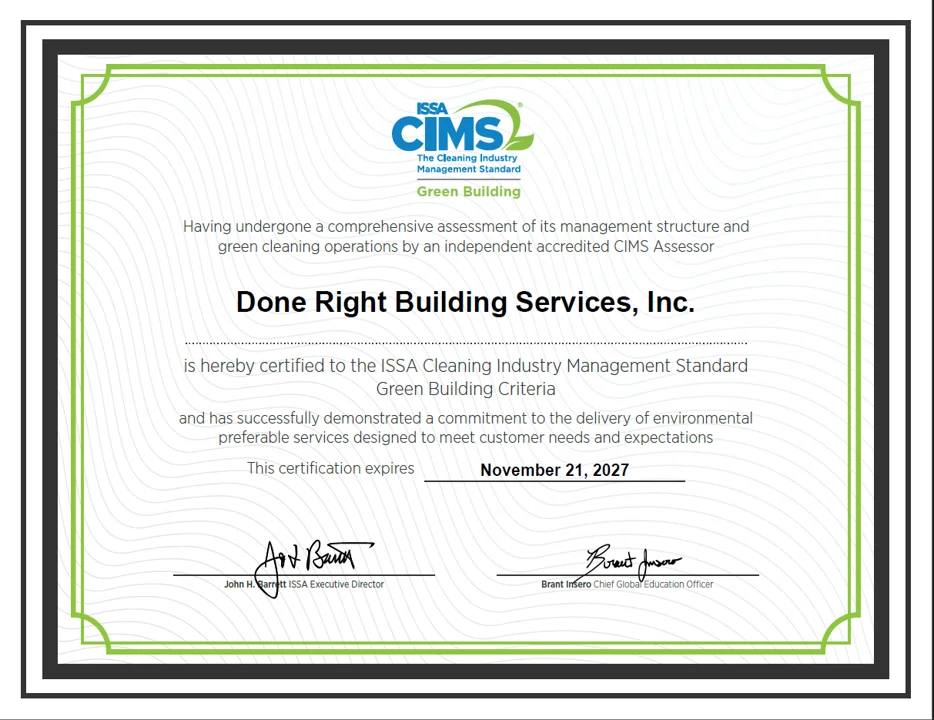
ISSA CIMS and CIMS-Green Building (CIMS-GB)
The Cleaning Industry Management Standard (CIMS), created by ISSA, sets the global standard for assessing professional commercial janitorial firms.
While baseline CIMS certification audits a service provider’s quality systems, human resources, and health policies, the advanced CIMS-Green Building (CIMS-GB) designation adds specific requirements for sustainable service delivery.
A contractor holding CIMS-GB credentials has demonstrated through rigorous third-party audits that they:
- Maintain an official, written Green Cleaning Policy tailored to client environments.
- Use environmentally certified cleaning products (Green Seal, UL ECOLOGO, or Safer Choice) across basic maintenance routines.
- Deploy certified energy-efficient floor equipment and vacuums equipped with high-efficiency particulate air (HEPA) filtration that captures 99.97% of airborne particles down to 0.3 microns.
- Train staff in ergonomic cleaning techniques, precise chemical dilution management, and integrated pest management (IPM) support.
Engaging a service partner that aligns with CIMS-GB principles ensures your building’s green program is applied consistently by trained professionals.
Why Certified Green Cleaning Matters for Corporate Workplaces
Investing in certified green janitorial services is more than an environmental statement; it delivers tangible corporate, financial, and operational returns.
Enhanced Indoor Air Quality and Productivity
The modern corporate office is a tightly sealed thermal envelope. When volatile cleaning agents evaporate from desks, glass dividers, and common-area floors, employees inhale those chemical compounds throughout the workday.
Transitioning to low-VOC, certified non-toxic formulas immediately lowers airborne particulate and chemical loads. Better indoor air quality has been linked repeatedly to decreased absenteeism, fewer chronic allergy symptoms, and improved cognitive performance among administrative personnel.
Supporting Corporate ESG and LEED Credentials
Commercial enterprises are increasingly required to document their carbon footprint, environmental sustainability, and employee wellness initiatives for investors, board members, and clients.
Deploying certified green cleaning operations allows organizations to earn immediate operational points under green building standards such as LEED v4.1 for Operations and Maintenance (O+M) and the WELL Building Standard. These credits enhance commercial property asset values and reinforce your company’s public commitment to environmental responsibility.
Protecting Facility Assets
Harsh industrial cleaners particularly those with extreme pH levels, solvent carriers, or abrasive chlorine additives gradually degrade expensive office finishes.
Strong chemicals can strip commercial floor sealants, dislodge carpet adhesives, pit architectural metal hardware, and haze acrylic sneeze guards or glass fixtures. Certified green formulations are engineered to clean effectively at neutral or balanced pH levels, preserving corporate fixtures, extending the life of commercial carpets, and protecting capital real estate investments.
Implementing Green Cleaning: A Strategic Facility Checklist
Transitioning an office building to an eco-friendly janitorial program requires systematic implementation. Building managers should follow a clear, phased approach to modernize their cleaning protocols:
- Perform a Chemical Audit: Review safety data sheets (SDS) for every cleaning product currently inside your maintenance closets. Replace uncertified sprays, synthetic deodorizers, and corrosive toilet cleaners with Green Seal, ECOLOGO, or Safer Choice approved alternatives.
- Standardize on Microfiber and Color Coding: Implement multi-surface microfiber cloths and flat mops. High-grade microfiber physically removes dirt and pathogens through microscopic capillary action, dramatically reducing the volume of chemical cleaner required. Use color-coded cloths (e.g., red for restrooms, blue for general office surfaces) to eliminate cross-contamination risks entirely.
- Deploy Closed-Loop Dilution Systems: Human error often leads cleaners to mix chemicals too strong, assuming that “more chemical equals more clean.” Automated, wall-mounted dilution stations ensure concentrates are mixed with exact proportions of water, saving money and preventing chemical residue on office surfaces.
- Partner with Professional Janitorial Experts: The most reliable path to a sustainable facility is partnering with experienced commercial contractors who understand sustainable cleaning practices from day one.

Partnering with Certified Commercial Cleaning Professionals
Designing, implementing, and maintaining a verified eco-friendly office environment requires professional expertise, commercial-grade equipment, and continuous staff oversight. Sourcing eco-friendly supplies is only one part of the equation; executing precise cleaning workflows without disrupting daily corporate operations requires an experienced team.
Commercial property managers benefit from working with established providers like POC Commercial Cleaning Solutions. Selecting an experienced partner with comprehensive commercial office and janitorial services ensures that daily dusting, floor restoration, and disinfection are handled with eco-friendly products and certified HEPA-filtration equipment.
A professional cleaning team can review your building’s current environmental footprint, align cleaning schedules with your corporate sustainability targets, and maintain a spotless, healthy workplace that employees and visitors appreciate.
Final Thoughts: Leading the Green Workplace Revolution
Transitioning to third-party certified commercial sanitation is no longer a niche preference; it is a fundamental standard for modern, responsible corporate facility management.
By prioritizing reputable green cleaning certifications for offices, enterprise organizations eliminate harmful indoor pollutants, meet critical ESG sustainability benchmarks, and build healthier, more productive workplaces. Investing in certified products and proven commercial cleaning partners ensures your facilities remain pristine, safe, and sustainable for years to come.